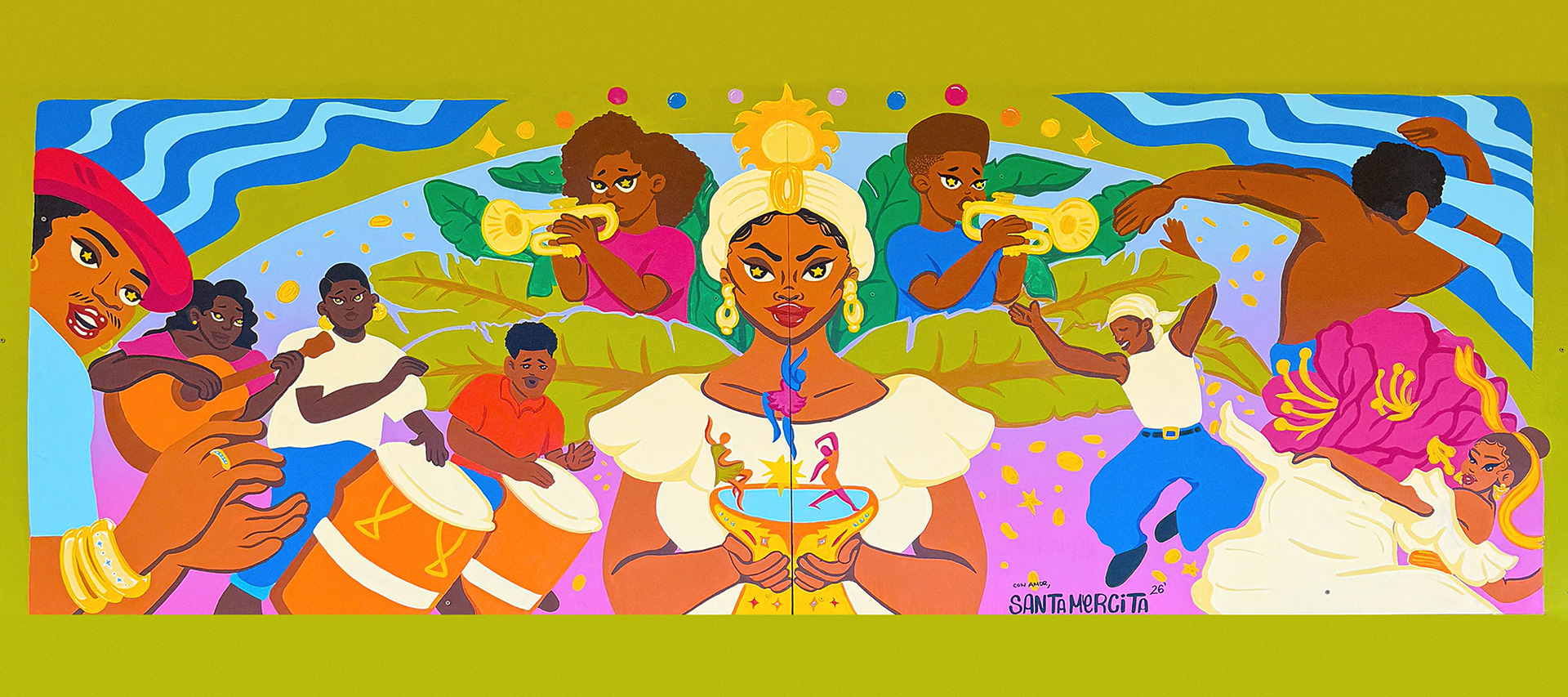
Cuerpos de Memoria (Bodies of Memory) is a celebration of queer Afro-Latino communities across Latin America, a visual representation in which sound and movement become vehicles for intergenerational healing, joy, and collective resistance.
Central Figure — The Mother of Creation:
At the heart of the composition stands a commanding female figure, rooted and expansive. She holds a small
drum from which a spark rises along with the activated spirits of sound. A symbol of spirit, memory, and the
creative force that sustains community. Drawing loosely from the energy of the Yoruba orisha Yemayá, mother
of all living things, she embodies the generative power of Afro-diasporic spiritual traditions. Behind her, broad
banana leaves frame the scene, invoking the sacred threshold between the human and the divine.
Intergenerational Transmission – The Children:
Flanking the central figure, two young children playing trumpets as a gesture of inheritance and continuity.
Their presence speaks directly to the theme of intergenerational healing: the deliberate, loving act of passing
down musical traditions as a form of cultural survival and identity.
Community in Motion – Left Side:
On the left, androgynous figures engage in bomba, the Afro-Puerto Rican drum and dance tradition, affirming
the full spectrum of gender expression within Afro-Latino cultural spaces. Their presence is both celebratory
and political by centering queerness.
Liberation and Frequency – Right Side:
On the right, figures move with unrestrained joy: one dances suspended in air, another reaches an arm upward
beyond the mural's upper border — a border rendered as undulating waves representing the frequency and
reach of sound itself. The gesture suggests that music and movement cannot be contained; they spill beyond
boundaries, into the world.
Grounding the Scene:
In the lower corner, a solitary woman dancer anchors the composition, connecting the energy of the collective
above to the earth below.
At the heart of the composition stands a commanding female figure, rooted and expansive. She holds a small
drum from which a spark rises along with the activated spirits of sound. A symbol of spirit, memory, and the
creative force that sustains community. Drawing loosely from the energy of the Yoruba orisha Yemayá, mother
of all living things, she embodies the generative power of Afro-diasporic spiritual traditions. Behind her, broad
banana leaves frame the scene, invoking the sacred threshold between the human and the divine.
Intergenerational Transmission – The Children:
Flanking the central figure, two young children playing trumpets as a gesture of inheritance and continuity.
Their presence speaks directly to the theme of intergenerational healing: the deliberate, loving act of passing
down musical traditions as a form of cultural survival and identity.
Community in Motion – Left Side:
On the left, androgynous figures engage in bomba, the Afro-Puerto Rican drum and dance tradition, affirming
the full spectrum of gender expression within Afro-Latino cultural spaces. Their presence is both celebratory
and political by centering queerness.
Liberation and Frequency – Right Side:
On the right, figures move with unrestrained joy: one dances suspended in air, another reaches an arm upward
beyond the mural's upper border — a border rendered as undulating waves representing the frequency and
reach of sound itself. The gesture suggests that music and movement cannot be contained; they spill beyond
boundaries, into the world.
Grounding the Scene:
In the lower corner, a solitary woman dancer anchors the composition, connecting the energy of the collective
above to the earth below.